
Choosing the best driveway sealcoating equipment in 2026 requires more than comparing engine power or tank capacity. Global buyers must evaluate climate, pavement condition, labor skills, transport limits, and local service support. A compact spray system may suit narrow residential drives, while a larger squeegee machine can improve output on commercial sites. The right choice depends on the work.
Industry reports offer useful context. The U.S. Federal Highway Administration continues to promote pavement preservation because timely maintenance can extend service life and delay expensive reconstruction. NAPA technical guidance also emphasizes proper surface preparation, material handling, and application consistency. These findings matter when comparing driveway sealcoating equipment, because weak cleaning, uneven spray pressure, or poor agitation can undermine an otherwise reliable machine. Equipment does not fix bad preparation.
This 2026 guide examines practical options for contractors, distributors, and property-service companies across different markets. It considers transferability, diesel and electric power, tank design, pump performance, filtration, operator safety, spare parts, and after-sales training. Buyers should also review regional emissions rules and electrical standards before ordering. Specifications can look impressive on paper.
Real job conditions are less tidy. Dust enters pumps. Hoses crack in heat. Cold mornings change material flow. Even experienced operators occasionally select equipment that is too large, too complex, or difficult to repair locally. That weakness deserves attention, not concealment. The following comparison therefore balances reported specifications with field usability, maintenance demands, and credible industry guidance, helping buyers make a more defensible investment decision.
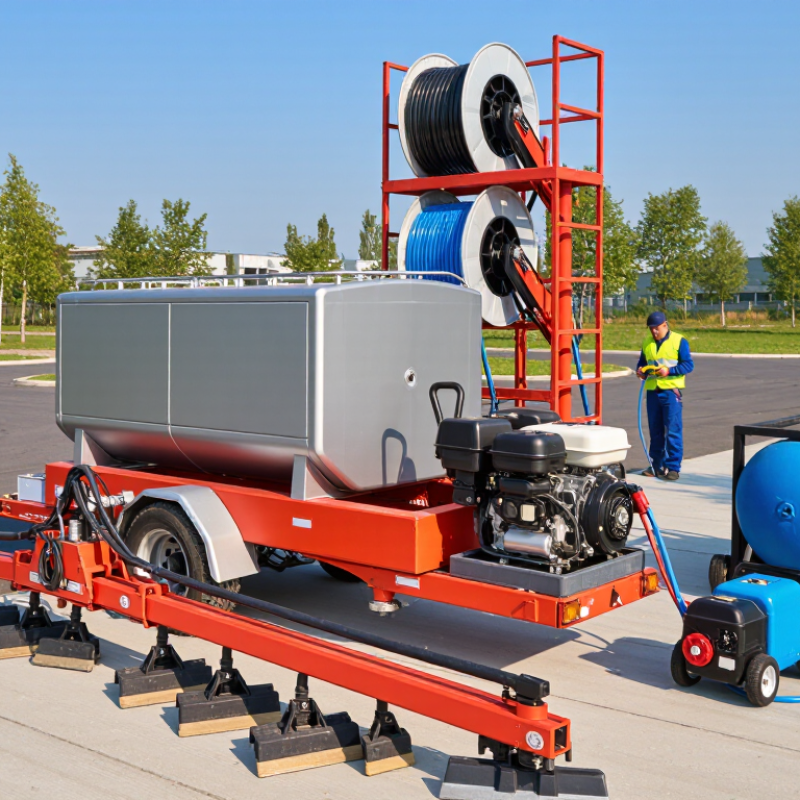
A practical sealcoating system includes a mixing tank, mechanical agitator, pump, spray wand, squeegee, hoses, filters, and safety controls. The agitator keeps mineral fillers suspended inside the tank. Without steady mixing, the first driveway section may receive thin liquid, while the final section receives heavy solids. That inconsistency is easy to see near garage entrances.
The pump moves the coating through a filtered line. The operator then sprays narrow edges and spreads broad areas with a squeegee. A small air compressor can clean fittings and support pneumatic components. Equipment capacity should match daily workload, surface texture, and local climate. The National Asphalt Pavement Association reported that 94.6 million tons of reclaimed asphalt pavement were used in 2022. That figure reflects the industry’s strong focus on material efficiency, although recycled asphalt is not automatically suitable for every sealcoat mix. Read the product data sheet carefully. Field experience still matters.
Tips: Check agitation speed before buying. Test the spray pattern with water. Keep spare filters nearby. Measure wet-film thickness during application. The Federal Highway Administration’s pavement-preservation guidance stresses timely maintenance before cracks become structural failures. However, sealcoating cannot repair deep potholes or unstable pavement. That limitation is often underestimated. A clean, dry surface, controlled application rate, and sufficient curing time usually matter more than impressive tank size.
Residential driveways usually need compact, easy-to-clean equipment. A hand squeegee gives precise control around garage edges and drainage channels. Small spray systems help cover larger surfaces with fewer lap marks. Choose an adjustable nozzle, a stable tank, and simple pressure controls. Keep it simple. Crack-filling tools are also important, because sealcoating cannot repair moving cracks or deep surface failures.
Commercial driveways require faster application and consistent material flow. A walk-behind spray unit can improve productivity across apartment entrances and office parking areas. Dual squeegees help distribute sealer evenly beside curbs, walls, and parked vehicles. Look for durable hoses, reliable agitation, and filters that resist clogging. Test the pattern. I have found that excessive pressure may create overspray, while weak pressure leaves uneven coverage. Operators should check pavement temperature, moisture, and local environmental requirements before work begins.
Industrial driveways often demand trailer-mounted systems, larger tanks, and stronger pumps. These machines reduce refill frequency across warehouses, loading zones, and service roads. Heated crack-filling equipment may support maintenance in colder regions, but temperature controls require careful training. Buyers should confirm electrical compatibility, transport limits, spare-part access, and operator safety features. A larger machine is not always better. Tight sites can make oversized equipment slow and wasteful. Some specifications look impressive on paper, yet daily cleaning and maintenance determine real performance. Photographing test sections can reveal curing problems before the full driveway is treated.
| Equipment Type | Typical Buyer / Application | Recommended Surface Area | Typical Working Capacity | Common Power Configuration | Material Handling | Best Use Case | Key Purchasing Considerations |
|---|---|---|---|---|---|---|---|
| Handheld Squeegee and Brush Set | Residential Homeowners, maintenance crews, and small contractors |
Up to approximately 300 m² per project | About 100–250 m² per day, depending on surface preparation and drying conditions | Manual operation; no external power required | Works with pails or small containers of water-based or refined-coal-tar sealers | Small driveways, patch repairs, edges, and areas where access is restricted | Choose durable rubber blades, corrosion-resistant handles, replacement blades, and compatible protective equipment |
| Small Agitated Sealcoating Tank | Residential Small paving businesses and property maintenance teams |
Approximately 300–1,500 m² per project | Roughly 150–500 m² per day | Electric agitator or small gasoline engine; commonly 12 V or compact engine-driven systems | Typically 200–600 L tank capacity with mechanical or paddle agitation | Residential driveways, small parking areas, and repeat maintenance work | Check tank clean-out access, agitation performance, hose length, spray control, and local electrical or engine regulations |
| Portable Spray System | Residential Commercial Contractors needing transport flexibility |
Approximately 500–3,000 m² per project | About 250–800 m² per day | Electric or gasoline-powered pump; typical pump output is approximately 15–40 L/min | Usually supplied from a 200–1,000 L tank; requires continuous agitation for filled sealers | Medium-sized driveways, small lots, rural properties, and locations without fixed equipment | Evaluate spray-tip availability, pressure control, overspray management, filter access, and compatibility with aggregate-filled products |
| Tow-Behind Sealcoating Trailer | Commercial Professional paving contractors and mobile maintenance crews |
Approximately 1,000–10,000 m² per project | About 500–1,500 m² per day | Gasoline engine or hydraulic drive; commonly powered independently from the towing vehicle | Typical tank capacity ranges from 1,000–3,800 L with hydraulic or mechanical agitation | Commercial driveways, parking lots, housing developments, and route-based maintenance | Confirm towing capacity, trailer braking requirements, axle rating, tank baffles, loading height, and road regulations in the destination market |
| Truck-Mounted Sealcoating System | Commercial Industrial High-volume paving and infrastructure contractors |
Approximately 5,000–50,000 m² per project | About 1,000–3,000 m² per day | Truck engine-driven hydraulic system or dedicated gasoline engine | Common tank capacities range from 2,500–7,600 L with continuous recirculation and agitation | Large parking areas, logistics yards, commercial campuses, and multi-site contracts | Review chassis payload, axle loading, pump serviceability, hose-reel design, operator ergonomics, and compliance with transport laws |
| Self-Propelled Sealcoating Machine | Commercial Industrial Contractors working on large or difficult-access sites |
Approximately 2,000–25,000 m² per project | About 800–2,500 m² per day | Hydrostatic drive or mechanical transmission with gasoline or diesel power | Typical tank capacity ranges from 1,500–4,500 L; spray bars and hand wands may be included | Large driveways, airports, industrial compounds, and sites requiring frequent repositioning | Consider turning radius, ground clearance, traction, braking, operator visibility, and parts availability |
| High-Pressure Surface Cleaner | All Segments Preparation crews, contractors, and facility managers |
Suitable for localized cleaning through large paved areas | Approximately 100–500 m² per hour, depending on pressure, flow, contamination, and surface condition | Electric motor or gasoline engine; professional systems commonly use approximately 140–280 bar working pressure | Uses clean water; wastewater collection may be required by local environmental rules | Removing dirt, oil residue, loose coating, and biological growth before sealcoating | Match pressure and flow to pavement condition; specify surface-cleaner diameter, water supply, wastewater controls, and nozzle availability |
| Crack Router and Crack Cleaning System | Commercial Industrial Professional pavement-repair contractors |
Linear crack-repair work on residential, commercial, and industrial pavement | Approximately 100–400 linear metres per day, depending on crack density and repair requirements | Electric or gasoline engine; commonly used with compressed air for cleaning | Prepares cracks for rubberized or hot-applied crack fillers; does not apply sealcoating itself | Improving crack-filler adhesion and extending the service life of sealcoated pavement | Check cutting depth control, dust management, wheel stability, blade availability, and compatibility with local crack-repair specifications |
| Air Compressor and Pavement Blower | All Segments Preparation crews and sealcoating contractors |
Small driveway preparation through large commercial sites | Preparation output varies with air volume, nozzle design, debris, and surface area | Electric or gasoline engine; compressor output is commonly specified in L/min or CFM | Dry air only; no coating material required | Removing dust, loose aggregate, and water from cracks and pavement before coating | Prioritize continuous air delivery, noise level, hose length, moisture separation, fuel efficiency, and worker safety |
| Hot Rubberized Crack-Filling Kettle | Commercial Industrial Specialist pavement maintenance contractors |
Projects with substantial crack networks or recurring pavement repairs | Approximately 100–500 linear metres per day, depending on crack width and preparation | Propane, diesel, or electric heating system, subject to local safety requirements | Common capacities range from 20–200 L; uses hot-applied rubberized crack filler | Sealing working cracks before applying a surface sealer | Verify temperature control, insulation, indirect heating, emergency shutoff, material compatibility, and operator training requirements |
| Pavement Marking Machine | Commercial Industrial Parking-area, logistics, and facility maintenance contractors |
Small parking layouts through large commercial and industrial sites | Productivity depends on layout complexity, paint type, and curing time | Manual push, battery-electric, or gasoline-powered configurations | Uses traffic-marking paint or thermoplastic systems; separate from sealcoating material | Reinstating parking bays, directional arrows, loading zones, and safety markings after sealcoating | Consider line-width adjustment, paint compatibility, nozzle control, cleanup procedure, and local accessibility-marking standards |
| Material Transfer and Mixing Tank | Industrial Large contractors, asphalt plants, and multi-crew operations |
More than 10,000 m² per project or continuous multi-site work | Designed for sustained production rather than a fixed daily area | Hydraulic, electric, or diesel-powered mixing and transfer system | Often 5,000–15,000 L or more, depending on project logistics and material supply | Bulk storage, consistent mixing, and rapid transfer to spray trucks or application machines | Evaluate viscosity control, agitation uniformity, loading method, containment, washout management, and regional transport requirements |
Note: Capacity and productivity figures are typical planning ranges rather than guaranteed outputs. Actual performance depends on pavement condition, coating formulation, aggregate content, weather, crew size, preparation quality, transport distance, and local safety and environmental regulations.
For global buyers in 2026, equipment comparison should begin with pavement conditions, not catalog claims. A sprayer needs stable pressure, adjustable nozzles, and a hose long enough for wide driveways. Airless systems can cover quickly, but overspray increases near walls, drains, and parked vehicles. Check pump seals, pressure gauges, and replacement parts before choosing a machine. I once focused too heavily on output rate. That choice made small residential jobs awkward.
Tank capacity should match crew size and transport limits. A large tank reduces refilling, yet it adds weight and cleaning time. For mixes containing aggregate, inspect the agitator and tank shape carefully. A weak mixer may leave solids settled at the bottom. That creates uneven application and unreliable coverage readings. Crack-sealing tools require controlled heat, accurate flow, and comfortable handling. Look for insulated handles, temperature controls, and tips suited to narrow or wide cracks. Electrical compatibility matters across countries, especially voltage, plugs, and generator requirements. Photographs alone are not enough.
Tips: Compare machines using the same material, surface, and weather conditions. Record gallons per hour, cleanup time, and visible coverage. Leave room for mistakes. A low-cost tool may become expensive when downtime, shipping, and unavailable parts are included. Before purchase, request a live demonstration or test panel. Keep safety guards, ventilation, and local operating requirements in the decision.
For global buyers in 2026, driveway sealcoating equipment should be judged by working specifications, not advertised output.
A practical starting point is pump capacity. Choose adjustable flow, typically 20–40 gallons per minute, with pressure control for narrow and wide surfaces.
Too much pressure can waste material and create uneven edges. A 100–300 gallon tank suits many contractors, but trailer weight and towing limits matter. Keep room for agitation and easy cleaning.
Engine selection needs attention in different climates and regions. Check fuel availability, noise limits, exhaust requirements, and cold-start performance before ordering. Electric systems may simplify indoor storage, but voltage and charging infrastructure vary widely. Confirm nozzle sizes, hose length, filter access, and spray-bar width. These details affect daily productivity more than a larger engine. Safety guards, emergency shutoff controls, stable frames, and clear operating labels deserve documented inspection. Ask for manuals, parts lists, test records, and applicable conformity documents.
Reliable equipment should tolerate dust, heat, humidity, and repeated washdown. Look for corrosion-resistant wetted parts and replaceable seals. Service access should be possible with ordinary tools. That is often overlooked. A warranty matters, yet local parts support may matter more. Request realistic delivery times and written maintenance intervals. Do not accept every catalog number without field verification. Coverage rates change with pavement texture, material temperature, and operator technique. I would test a small area before full deployment. The result may expose assumptions hidden in the specification sheet.
Choosing driveway sealcoating equipment in 2026 requires more than comparing spray rates and tank capacity. Global buyers should examine operator protection, maintenance access, shipping limits, and local compliance. A guarded pump, emergency shutoff, stable hose connections, and clear pressure controls reduce daily risks. Keep safety data sheets with every coating shipment. Some regions require translated labels, specific electrical plugs, or documented conformity for powered equipment.
Maintenance planning should begin before purchase. Check whether filters, seals, nozzles, and pump diaphragms are available locally. Clean the system after each shift, especially when material begins drying around the spray tip. Small leaks become expensive quickly. I have seen overlooked hose fittings delay a project more than weak equipment performance. That assumption deserves review. A compact unit may save freight space but demand more frequent refilling and cleaning.
Shipping conditions also deserve careful measurement. Confirm crate dimensions, gross weight, lifting points, and battery or fuel restrictions before booking transport. Coating materials may face separate import, storage, or temperature requirements. Buyers should verify customs documents, tariff codes, insurance, and destination rules with qualified local authorities. Regulations differ between countries and may change without notice. Keep inspection records, training logs, and repair dates; they support accountability when equipment crosses borders. Moisture, freezing temperatures, and rough handling can damage equipment before the first job.
Typical commercial equipment planning ranges for capacity, spray hose reach, safety, maintenance, shipping, and regulatory review.
The ranges shown are representative planning values used for commercial sealcoating equipment. Actual specifications vary by pump design, material viscosity, vehicle configuration, and local requirements. Buyers should confirm safety data sheets, emissions rules, electrical standards, transport limits, and maintenance support before purchase.
Specify splash protection, chemical-resistant gloves, eye protection, ventilation, emergency wash facilities, and guarded moving parts.
Flush pumps and hoses after use, inspect seals and filters, protect spray tips from blockage, and document preventive maintenance.
Check total packed weight, lifting points, crate dimensions, container clearance, battery or fuel rules, and destination import documents.
Verify local VOC limits, chemical labeling, worker exposure controls, road-vehicle rules, electrical conformity, and waste-disposal obligations.
It usually includes a mixing tank, mechanical agitator, pump, hoses, filters, spray wand, squeegee, and safety controls. A small air compressor may clean fittings and support pneumatic parts.
Agitation keeps mineral fillers suspended in the tank. Without it, early areas may receive thin liquid and later areas may receive heavy solids. The difference can show near a garage entrance.
Match tank size and pump capacity to daily workload, surface texture, and local climate. A large tank is not always better. Small units may require frequent refilling.
Test the spray pattern with clean water first. Check the width, pressure, and coverage across the wand. Keep spare filters nearby because blocked filters interrupt work.
The pavement should be clean and dry. Remove dirt, loose material, and standing water. Sealcoating cannot repair deep potholes or unstable pavement.
Control the application rate and measure wet-film thickness during work. Allow enough curing time before opening the driveway. Field judgment still matters, sometimes more than tank size.
Look for a guarded pump, emergency shutoff, stable hose connections, and clear pressure controls. Keep safety data sheets with each coating shipment. Training records are useful, too.
Confirm local access to filters, seals, nozzles, and pump diaphragms. Clean the system after every shift, especially around the spray tip. Small leaks become costly quickly.
Confirm crate dimensions, gross weight, lifting points, and power or fuel restrictions. Review customs documents, tariff codes, insurance, and destination rules with qualified local authorities.
Moisture, freezing temperatures, and rough handling can cause damage before the first job. Inspect the equipment after arrival. My earlier assumption was that packaging solved everything; it does not.
Choosing the best driveway sealcoating equipment in 2026 requires understanding how each component supports efficient, consistent, and safe pavement maintenance. A complete system may include storage tanks, agitation or mixing units, spray systems, hoses, pumps, squeegees, and crack-sealing tools. Residential projects often benefit from compact, easy-to-transport equipment, while commercial and industrial applications may require larger capacities, stronger pumps, higher productivity, and more durable construction. Buyers should compare spray patterns, tank volume, mixing performance, pressure control, application speed, portability, and compatibility with different sealcoating materials.
For global buyers, driveway sealcoating equipment should also be evaluated for electrical requirements, spare-parts availability, operator safety features, cleaning procedures, corrosion resistance, packaging, shipping conditions, and technical support. Proper maintenance, including routine inspection, flushing, lubrication, and storage, can extend service life and reduce downtime. Buyers should also verify that equipment, labeling, transport documents, and workplace practices meet the applicable requirements in their destination market. A well-matched system can improve coverage, reduce material waste, and support reliable results across a wide range of driveway projects.
